
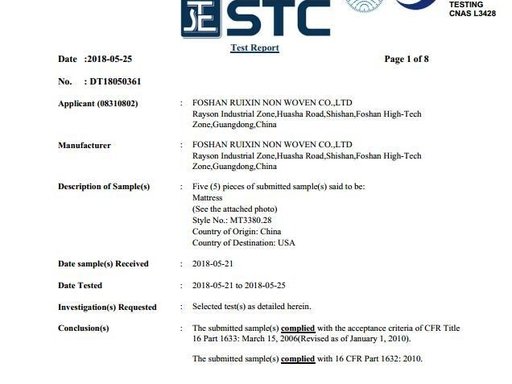
Exporting adjustable mattresses to the United States and UK requires strict compliance with local fire safety regulations. Among all mandatory certifications, CFR1633 (USA) and BS7177 (UK) are non-negotiable core certificates—without them, shipments face customs detention, fines, or even rejection. This article decodes these two critical flame-resistant standards, details their key test items, and explains how they streamline cross-border logistics for global mattress exporters.
1. CFR1633: Mandatory Open-Flame Standard for US Mattress Exports
1.1 Standard Overview
16 CFR Part 1633 (formulated by CPSC) is the US federal mandatory open-flame fire safety standard for all mattress sets (including adjustable zero-gravity mattresses). Effective since 2006, it aims to limit mattress heat release in residential fires and reduce flashover risks. It works alongside 16 CFR 1632 (cigarette smoldering test) for full compliance.
1.2 Core Test Items & Pass Criteria
The test uses two propane burners to apply high-intensity open flames to the mattress top and side simultaneously. Key metrics:
- Peak heat release rate: ≤ 200 kW at any point within 30 minutes.
- Total heat release (first 10 mins): ≤ 15 MJ.
- Labeling requirement: Permanent English label with manufacturer/importer info and compliance statement.
1.3 Compliance Requirement
All materials (fabric, foam, fire barriers) must pass full-mattress composite testing. No component-only approval—the entire mattress set must meet the standard.
2. BS7177: UK’s Risk-Based Fire Safety Standard for Mattresses
2.1 Standard Overview
BS 7177:2008+A1:2011 (BSI) is the UK’s primary flame-resistance standard for mattresses, bed bases, and sofa beds. It classifies products into Low/Medium/High hazard levels (residential, hotel, hospital). It aligns with EU EN 597 (cigarette/match tests) but imposes stricter requirements for high-risk scenarios.
2.2 Core Test Items & Pass Criteria
It adopts a multi-source :
- Smoldering cigarette test: No sustained combustion or charring beyond limits.
- Match-flame equivalent test: Resists small open flames (EN 597-2).
- Open-flame test (high hazard): Evaluates flame spread, damage length, and dripping ignition risk.
- Key pass rule: No ignition, no flaming drips, and self-extinguishes within specified time.
2.3 Compliance Requirement
Covers all components: ticking fabric, foam, springs, and threads. Public-sector mattresses (hotels, care homes) need High-hazard level approval.
3. Why These Two Certifications Are Critical for US/UK Customs Clearance
3.1 Non-Negotiable Customs Entry Ticket
- USA: CPSC enforces CFR1633 strictly—customs audits certificates; non-compliant goods are detained, destroyed, or fined up to $15,000 per unit.
- UK: BS7177 is a legal requirement under the Furniture and Furnishings (Fire) (Safety) Regulations. Missing certificates lead to port rejection and market ban.
3.2 Reduced Inspection & Quarantine Risks
Certified products undergo faster customs clearance with lower random inspection rates. Third-party lab reports (e.g., Intertek, SGS) further boost clearance efficiency.
3.3 Brand Credibility & Market Access
Beyond compliance, certifications prove product safety to US/UK buyers. Retailers, hotels, and distributors only source certified mattresses—non-compliant products are locked out of mainstream channels.
4. Key Differences Between CFR1633 and BS7177
| Aspect | CFR1633 (USA) | BS7177 (UK) |
|---|---|---|
| Core Focus | Open-flame heat release control | Risk-based multi-source ignition resistance |
| Test Fire Source | Dual propane burners (high-intensity open flame) | Cigarette, match flame, open flame (by hazard level) |
| Pass Metric | Peak heat ≤200kW; 10-min total heat ≤15MJ | No sustained combustion, no flaming drips |
| Applicability | All residential mattresses | Residential (Low), commercial (Medium/High) |
| Labeling | Mandatory permanent English label | Hazard level + compliance mark |
5. How to Secure CFR1633 & BS7177 Certifications for Your Mattresses
- Material Selection: Use fire-retardant fabrics, OEKO-TEX certified foam, and fire barrier layers compatible with both standards.
- Prototype Testing: Submit full mattress samples to CPSC-recognized (USA) or BSI-accredited (UK) labs for testing.
- Labeling & Documentation: Add compliant labels and prepare test reports + certificates for customs and buyers.
- Batch Consistency: Ensure mass production matches tested samples to avoid compliance gaps.
Conclusion
CFR1633 (USA) and BS7177 (UK) are indispensable passports for mattress exports to these markets. They not only ensure fire safety but also enable smooth customs clearance, reduce trade risks, and unlock long-term wholesale cooperation with US/UK distributors. For adjustable mattress manufacturers targeting Western markets, prioritizing these two certifications is the first step to sustainable cross-border success.